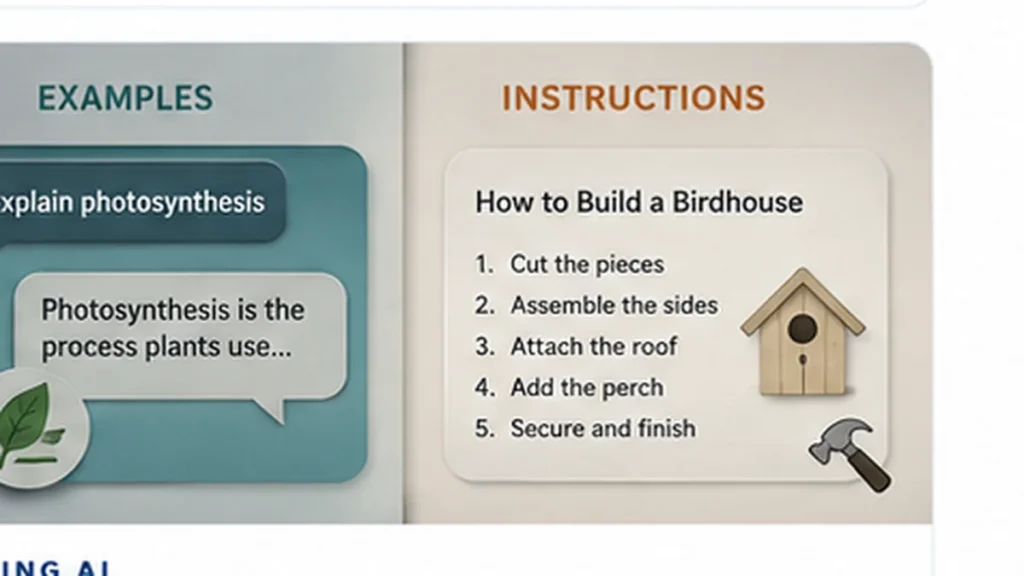
Quick Answer
Neither examples nor instructions are universally better.
Instructions are best for requirements we can state clearly.
Examples are especially useful when the desired quality is difficult to describe precisely.
Our best results came from combining them: instructions define what must be true; examples demonstrate what good looks like.
The mistake is turning every visible characteristic of the example into a rule.
Why Examples Help
Imagine trying to describe a particular article style entirely through rules.
Useful. Detailed but not padded. Skimmable without becoming superficial. Practical. Natural headings. Enough depth for the subject.
We can keep adding adjectives.
Or we can show AI a strong article and say:
"This is the quality we're trying to preserve."
The example communicates relationships that may be cumbersome to describe individually.
We Learned This With a Gold-Standard Article
A strong finished article became a useful reference for later work.
That helped us identify characteristics we valued.
But it also created a trap.
If the example happened to contain a certain number of sections, that didn't mean every future article needed the same number.
If it happened to be a certain length, that didn't mean every topic had equal informational capacity.
The example demonstrated quality. Its measurements were not automatically the definition of quality.
Instructions Are Better for Hard Constraints
If something absolutely must happen, say it.
For example:
"Do not invent a source."
"Preserve the existing function name."
"Use the supplied dimensions."
"Don't include an unrelated project."
Those aren't stylistic examples. They're requirements.
Examples Are Better for Tacit Qualities
Examples shine when we mean things such as this level of explanation, this amount of practical detail, this style of organization, this balance between concise and thorough, or this degree of visual consistency.
They give AI something concrete to pattern against.
Examples Can Cause Over-Imitation
The model may reproduce section structure, phrasing, length, rhythm, or details more literally than we intended.
So we now explain why the example is good.
That gives the model a better target than surface imitation.
Current OpenAI Guidance Supports Both
OpenAI's current prompting materials emphasize clear instructions, context and desired output. Examples remain a standard way of making an expected pattern concrete when explanation alone isn't sufficient.
Our Preferred Formula
Requirement: State it.
Quality that's difficult to articulate: Show it.
Example-specific accident: Don't turn it into a standard.
That simple distinction prevents a surprising amount of workflow drift.
Worthy Trying Verdict
Instructions: Best for explicit constraints
Examples: Best for demonstrating difficult-to-describe qualities
Best overall: Use both for different jobs
Human oversight: Low to medium
Would we keep benchmark examples? Yes
The lesson: Use examples to demonstrate quality, not to accidentally turn one successful output into a template everything must imitate.