AI Reliability
Why AI Performs Better When Results Are Testable
AI becomes more dependable when the result can collide with reality: run the code, measure the object, open the page or check the source.
Read experimentAI can be useful and still be wrong in convincing ways. These experiments focus on verification, self-review, repeated mistakes, unintended changes, and the conditions that make trust more reasonable.
AI self-review can catch mistakes, but it isn't independent verification. Here's where checking its own work helped us—and where it failed.
Read the starting experimentAI becomes more dependable when the result can collide with reality: run the code, measure the object, open the page or check the source.
Read experimentSome AI output can be used with light review. The key is reversibility, consequence, factual dependence and whether you can notice a bad result.
Read experimentOur AI failures kept repeating the same patterns: confident errors, drift, hidden dependencies, inconsistency and unnecessary complexity.
Read experimentYou do not need to verify every AI sentence equally. Use consequence, uncertainty and external tests to focus checking where it matters.
Read experimentAI can often identify weaknesses in its own response when asked to critique it, but self-critique is not the same as independent verification.
Read experimentAI can produce fluent, confident explanations that are still wrong. We learned to separate plausibility from evidence and test important outputs.
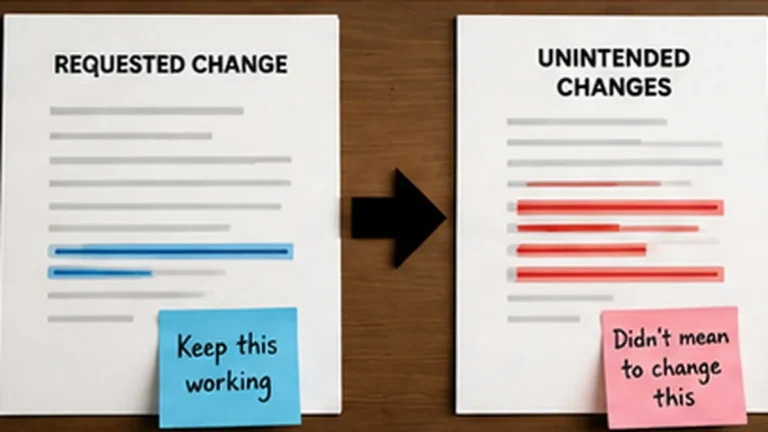
Read experimentAI can solve the requested problem while also changing nearby content, code, or visuals. Learn why it happens and how preservation constraints reduce the risk.
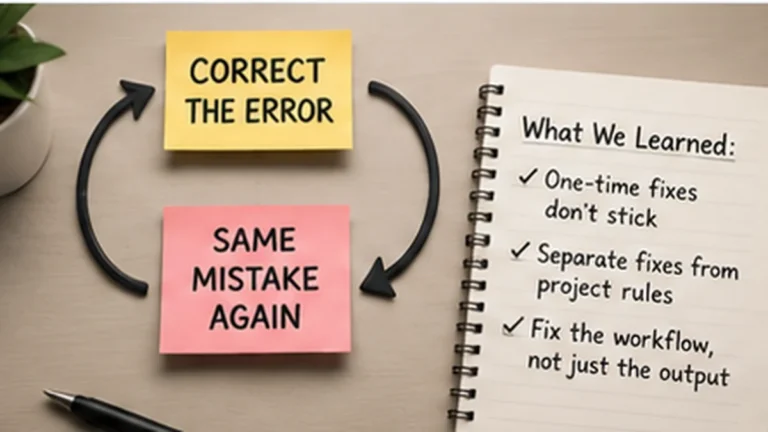
Read experimentCorrecting AI once doesn't guarantee the mistake is gone. We learned to separate one-time corrections from project rules and workflow failures.
Read experiment