
Quick Answer
AI has been most useful to us when the task is bounded, the inputs are visible, the desired result can be described, and there is some way to inspect or test the output.
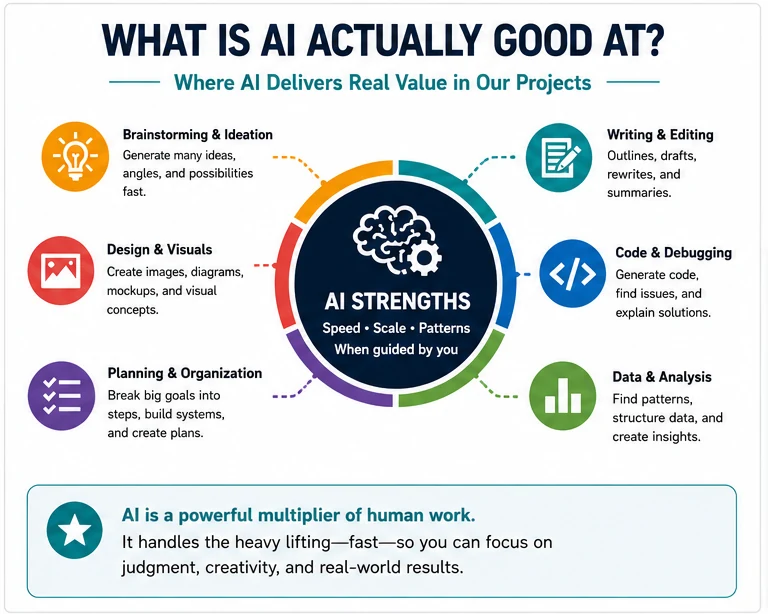
Its strongest roles have been drafting, reorganizing information, comparing options, synthesizing research, troubleshooting from concrete evidence, generating first implementations, and turning accumulated project experience into usable material.
The pattern matters more than the individual tool: AI performs best when it is helping move work through a process rather than being asked to replace reality, evidence, or judgment.
We Did Not Reach This Conclusion From One Prompt
Worthy Trying grew out of weeks of using AI on actual projects: website work, content production, image generation, construction instructions, SEO research, debugging, business comparison, workflow design and repeated attempts to make those systems scale.
Some experiments worked immediately. Others needed several revisions. A few approaches became so complicated that we eventually abandoned them.
That history gives us a better question than “Is AI good?” The useful question is: what kind of work repeatedly became easier when AI was involved?
AI Is Very Good at Turning Mess Into Structure
One of the most repeatable successes was synthesis.
Give AI a pile of notes, failures, observations and partial conclusions and it can often reorganize them into themes, comparisons, questions or an action plan much faster than we could manually sort the same material.
That does not mean the model discovered the underlying facts. The facts came from the work. AI helped us see the structure inside them.
This is exactly how the Worthy Trying article collection became possible: the research and failures took weeks; extracting multiple useful lessons from that accumulated experience became comparatively fast.
AI Is Good at Drafting Once the Job Is Clear
Writing itself was rarely the bottleneck once we knew what an article needed to accomplish.
AI could turn a locked scope into a readable first draft, rewrite weak sections, tighten explanations, generate alternate structures and help connect related ideas.
Where it became weaker was when we expected prose generation to decide the editorial problem for us. Smooth writing could hide a weak topic, unnecessary length or an unsupported conclusion.
So we learned to separate deciding what deserves to be said from generating the wording.
AI Is Strong at Comparing Many Pieces of Information
Competitive research and business analysis exposed another strength.
AI can hold many observations in view at once and group them by pricing, positioning, trust, conversion, customer fit or another useful dimension.
That makes it valuable when the human problem is not lack of information but too much scattered information.
The same ability helps with SEO research: current search evidence can be collected first, then AI can compare recurring questions, page types, gaps and patterns.
AI Can Be Excellent at Troubleshooting When There Is Evidence
Screenshots, error messages, failing code, visible layout problems and exact symptoms give AI anchors.
We had much better debugging results when we could say, “Here is the error, here is the relevant code, here is what should happen, and here is what actually happens,” than when we simply asked it to fix something vague.
Coding is especially useful because generated solutions can often be executed and tested. That turns AI from a persuasive answer generator into a fast hypothesis-and-implementation tool.
AI Is Good at Exploring Designs—But Not Automatically at Preserving Them
Image generation was extremely useful for exploring visual directions, advertising concepts, logos, drink graphics and supporting article visuals.
It was less reliable when the job required the exact same physical object to remain structurally identical across multiple views.
That distinction taught us an important general rule: creative variation is a strength when variation is allowed. The same tendency becomes a weakness when exact preservation is the requirement.
AI Is Useful at Critiquing Work, but Not as Independent Proof
AI can often identify weaknesses in an answer, article, workflow or piece of code when explicitly asked to critique it.
That is useful. It is not the same as independent verification.
A model can miss the same assumption twice. NIST's Generative AI Profile identifies confabulation—confidently presented erroneous content—as a real generative-AI risk. That is why our strongest workflows introduce external evidence whenever correctness matters.
The Conditions Behind Our Best Results
Across the projects, the successes tended to share five conditions.
The task had a clear boundary.
Relevant context was available.
The expected result could be described.
The output could be inspected, compared or tested.
And a human still owned the final decision.
When several of those conditions disappeared, reliability usually dropped.
What AI Did Not Replace
AI did not replace the need to know what the project was trying to accomplish.
It did not make weak evidence strong.
It did not automatically know which historical project rule was still authoritative.
It did not guarantee that an image was physically accurate because it looked realistic.
And it did not make generated code production-ready merely because it ran once.
The value came from combining AI's speed with constraints that existed outside the model.
Why This Matters for Worthy Trying
Google's current guidance for generative AI features in Search emphasizes unique, useful, non-commodity content and specifically contrasts firsthand perspective with simply restating material that could be generated from existing web content.
That fits the publication model we arrived at through experience: do real work first, then use AI to help extract and communicate what the work taught us.
Worthy Trying Verdict
Worked: Yes
Best at: Synthesis, drafting, comparison, bounded troubleshooting and rapid iteration
Weakest condition: Open-ended tasks with no external way to judge correctness
Human oversight: Still important
Best general rule: Give AI a job inside a process, not unquestioned authority over the process
The lesson: AI is most impressive when it amplifies evidence, structure and iteration that already have somewhere real to anchor.