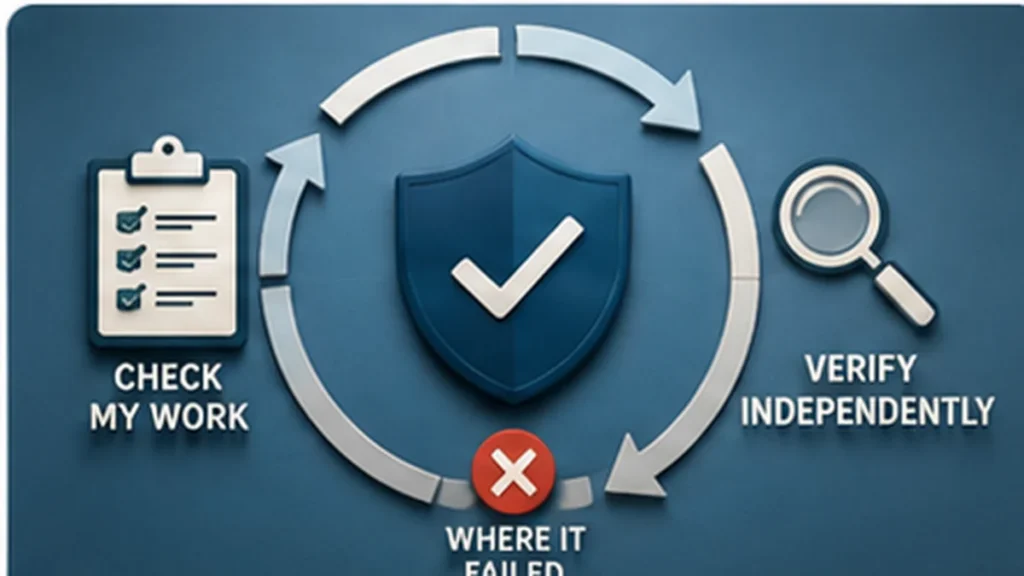
Quick Answer
AI can check its own work and often catch genuine problems.
We use that capability.
But we don't treat AI self-review as independent proof that the original answer is correct.
The same system that made an incorrect assumption can preserve that assumption during review.
Self-review works best when AI has something external to check against: source material, test results, specifications, current research or clearly defined acceptance criteria.
Why Self-Review Looks So Powerful
The workflow seems ideal.
AI creates an answer. Then we say: "Check your work."
It finds three problems. It corrects them.
That feels like a complete quality-control system.
Sometimes it genuinely improves the result. We saw enough useful corrections that self-review became tempting as a validator.
That's where we had to become more careful.
The Same Assumption Can Survive Both Passes
Suppose AI misunderstands what an article is supposed to accomplish.
It writes the article based on that misunderstanding. Then it reviews the article against the same interpretation.
The review can be internally consistent and still miss the actual problem.
This is why "I checked it and it looks correct" isn't strong evidence when the checker and creator share the same information.
We Saw This in Long Production Work
During our content experiments, we created increasingly elaborate checks for article depth, structure and completeness.
A validator could tell us that a page satisfied the measurements we gave it.
That did not necessarily answer the larger editorial question:
"Is this actually a useful article?"
Eventually we stopped treating proxies as proof.
External Evidence Changes the Task
Self-review becomes much stronger when we can say:
"Compare these dimensions against the cut list."
"Check these factual claims against these sources."
"Run this code and compare the result with the expected output."
"Compare this article against the actual search intent we researched."
Now the model isn't simply evaluating its own reasoning. It has evidence.
NIST Identifies the Underlying Reliability Problem
NIST describes generative-AI "confabulation" as confidently presented erroneous or false content and notes that outputs can also contradict earlier generated statements.
A confident self-review therefore shouldn't be confused with external verification.
Where AI Self-Review Is Useful
We've found it good for questions such as:
Does this contradict itself?
Did I omit one of the supplied requirements?
Which claims lack a cited source?
Where does this repeat itself?
Does the output match the requested format?
Those are constrained checks.
Where We Want More
For consequential factual accuracy, working code, physical construction, current information or claims based on outside evidence, we want something independent of the generated answer.
That may be a source, a test, a measurement, a specification, current web research, or human inspection.
Worthy Trying Verdict
Can AI find mistakes in its own output? Yes
Is self-review independent verification? No
Best use: Targeted checks against explicit criteria
Human oversight: Medium to high when correctness matters
Would we continue using AI self-review? Yes
The lesson: AI reviewing AI can improve an answer. Evidence tells us whether the answer is actually right.