
Quick Answer
The problems we repeatedly encountered were not random.
AI struggled most when correctness depended on hidden context, exact preservation, long project history, independent verification, physical consistency, or knowing when enough was enough.
It could also produce highly convincing output that was still wrong.
The practical response is not to stop using AI. It is to recognize which tasks need stronger constraints, external checks or human ownership.
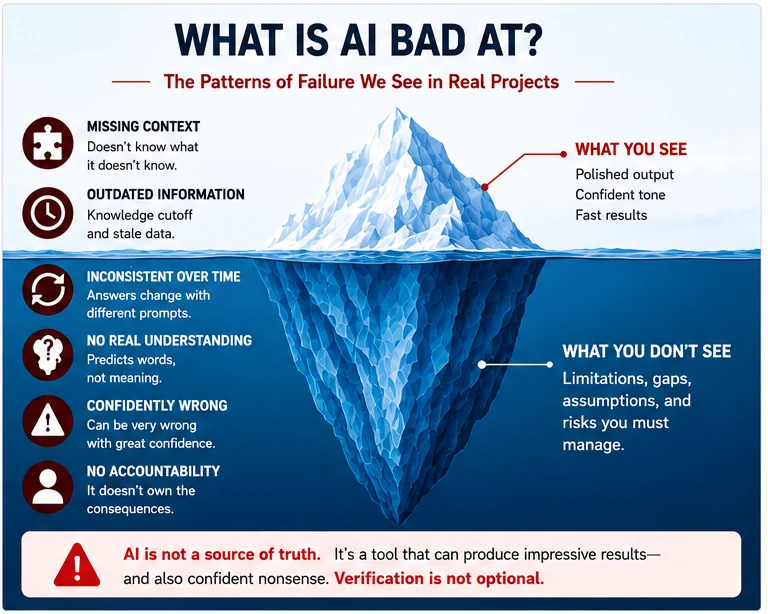
AI Can Be Wrong Without Looking Wrong
The most important weakness is plausibility.
A weak answer is easy to distrust when it sounds confused. A fluent answer with a clean explanation is harder.
We repeatedly saw that presentation quality and correctness are separate things. NIST describes generative-AI confabulation as confidently presented erroneous or false content, including outputs that contradict inputs or earlier statements.
That means confidence cannot be our verification method.
AI Does Not See Dependencies You Did Not Give It
This became obvious in code.
A local fix could solve the visible problem while damaging another feature because the changed function, stylesheet or template had relationships outside the supplied context.
The same problem appears outside programming. A workflow recommendation may ignore a business constraint the model was never told. An article revision may violate a project rule that exists only in an older conversation.
Invisible context produces invisible risk.
AI Can Drift During Long Projects
Long projects accumulate decisions.
Some are permanent. Some are experiments. Some are later replaced.
Without a concise current source of truth, AI may reintroduce an old idea, overemphasize a historical correction or treat a temporary workaround as a permanent requirement.
We learned that conversation history is useful, but it is not the same thing as project authority.
AI Struggles With Exact Visual Identity
Image generation exposed a different failure mode.
A generated cart could look excellent in several images while quietly changing wheel placement, frame geometry, dimensions or structural details between views.
For decorative work, that variation may not matter.
For a build article, product depiction or factual visual, it can make the image misleading.
Realism is not factual consistency.
AI Will Keep Expanding When the Instruction Rewards Expansion
AI rarely reaches a natural stopping point the way a human writer facing time and effort does.
If we say “make it longer” or “make it more comprehensive,” it can continue producing introductions, examples, background and summaries after the reader's real need has already been satisfied.
This is why we stopped using article length as a production target and started asking what meaningful in-scope question remained unanswered.
AI Can Overcorrect
A requested change sometimes caused unrelated changes.
A redesign request could alter elements we intended to preserve. A code fix could touch more files than necessary. A rewritten article could lose a useful feature while improving another.
We became much more explicit about preservation constraints: what must change and what must not.
AI Self-Critique Is Helpful but Circular
We can ask AI to review its own answer and it often catches problems.
But the same system may share the assumptions that created the original mistake.
Self-review is therefore a quality-improvement step, not independent evidence.
When the consequence matters, the answer needs a check outside the same reasoning loop.
AI Workflows Can Become Their Own Problem
One of our biggest failures was process bloat.
Each mistake seemed to justify another validator, exception, instruction or specialized stage. Eventually the system was spending too much effort managing the system.
The surprising lesson was that AI can make complexity cheap to create too.
Simplification became a form of maintenance.
The Weaknesses Often Come From the Same Root
Many of these failures have a common structure.
AI is generating the most plausible next result from the context it has. It is not standing outside the project with complete knowledge of reality.
If reality matters, we need to connect the generation process back to reality through tests, sources, measurements, specifications, human observation or another independent constraint.
Worthy Trying Verdict
Problems observed: Repeatedly
Most dangerous failure: Convincing output that is wrong
Most common project failure: Missing or stale context
Most stubborn visual failure: Exact object consistency
Best defense: External constraints and clear preservation rules
The lesson: AI's weaknesses become manageable when we stop treating fluent generation as evidence that the underlying job is correct.