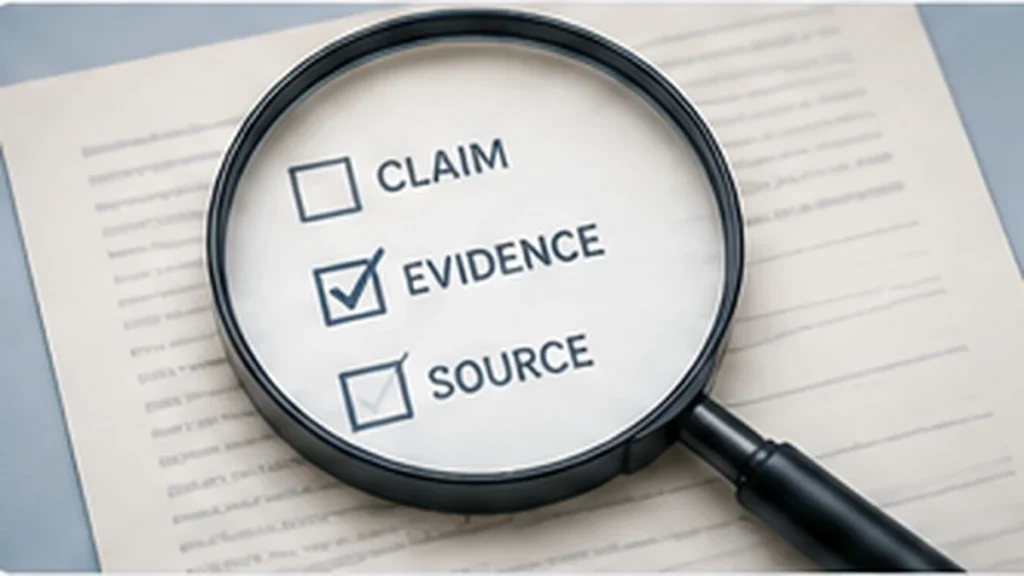
Quick Answer
Do not treat every part of an AI response as equally risky.
Verify the claims that are consequential, externally factual, difficult to reverse, unusually specific, dependent on current information, or central to the decision you are making.
Use direct tests when possible. Use authoritative sources for factual claims. Use spot checks for lower-risk material.
The goal is not zero verification. It is verification proportional to the cost of being wrong.
Why Checking Everything Defeats the Point
If every AI-assisted task requires independently reconstructing every sentence, much of the speed advantage disappears.
The opposite extreme—checking nothing—is worse.
We needed a middle ground that lets AI accelerate work without turning fluency into blind trust.
Start With Consequence
Ask what happens if this part is wrong.
A wording suggestion for a casual paragraph has a different risk than a code change that handles authentication, a construction dimension, a legal deadline or a current price.
The higher the consequence, the stronger the verification should be.
Check Claims That Depend on the Outside World
AI is weakest as its own source for facts that need current or independent confirmation.
Dates, prices, policies, specifications, citations, laws, product features, medical information, security guidance and current search behavior all have realities outside the conversation.
Those deserve an external source rather than another confident AI explanation.
Prefer Tests Over Opinions When a Test Exists
Some tasks offer a better form of verification than research.
Run the code.
Open the page.
Calculate the dimensions.
Compare the image against the specification.
Check the file.
Try the workflow.
A direct observable test can settle questions that would otherwise invite another round of generated reasoning.
Verify the Load-Bearing Claims
Most long answers contain a few claims that support everything else.
If the recommendation depends on an assumption about customer behavior, verify or test that assumption first.
If an article's conclusion depends on a Google policy, check the actual policy.
If a plan depends on one measurement, confirm the measurement.
We get more value by checking the load-bearing parts than by treating every adjective as equally important.
Use Sampling for Repetitive Low-Risk Output
At scale, repeated work can sometimes be checked by sampling.
If AI generates 40 similarly structured metadata entries, we can inspect a representative set plus known high-risk cases instead of manually rebuilding all 40.
Sampling only works when the task is genuinely repetitive and the cost of an undetected error is acceptable.
Ask AI to Expose What Needs Verification
AI can help create the verification plan.
Ask it to identify which claims are factual, current, inferred, uncertain or consequential.
That is useful triage.
Do not let the same model's confidence rating become the final proof. Use the list to decide where external checking belongs.
Create a Verification Budget
A practical workflow can assign effort by risk.
Low risk: quick inspection.
Medium risk: spot-check or compare against a source.
High risk: direct independent verification, testing or expert review.
This prevents both extremes: careless trust and exhaustive checking of trivial material.
NIST's Risk Framing Supports Proportional Oversight
NIST's Generative AI Profile treats risk management as context-dependent and highlights confabulation as a risk when users act on confidently wrong output.
That is consistent with our practical experience: verification effort should follow the consequence and context of the task rather than a universal rule that every AI sentence receives the same scrutiny.
Worthy Trying Verdict
Can verification be efficient? Yes
Best first filter: Consequence of error
Best verification: Direct external test when available
AI self-check: Useful for triage, not proof
Human oversight: Concentrated on load-bearing claims
The lesson: Verify what could change the decision, break the result or mislead the reader—not every harmless sentence with equal intensity.