Quick Answer
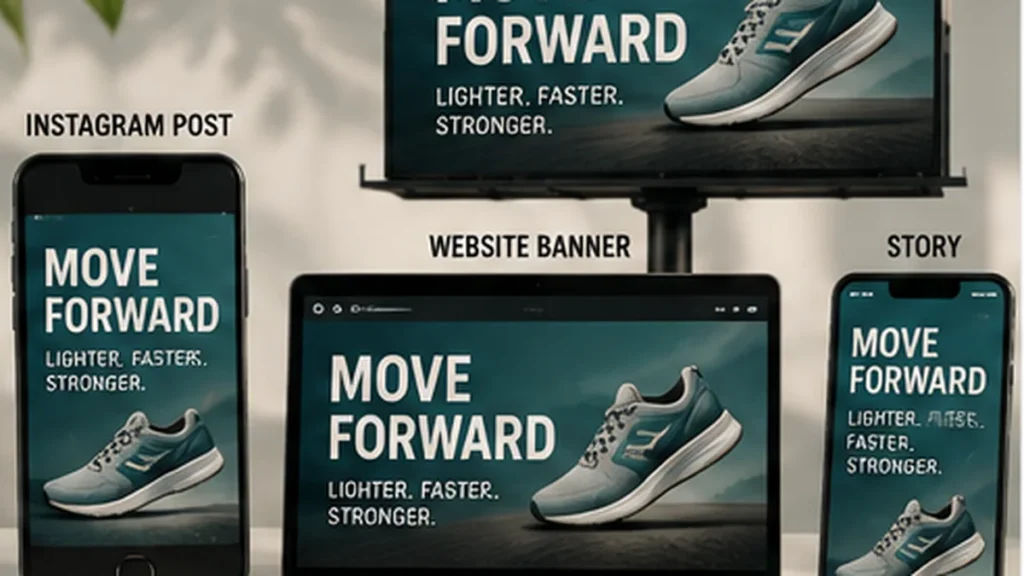
AI can help create advertising concepts across multiple formats, but the layout needs to be designed for the intended aspect ratio, viewing distance and use.
Simply enlarging the original image is not the same as redesigning it.
We Learned This While Adapting Promotional Graphics
A square or screen-oriented design can contain detail that works when viewed up close. When the same idea becomes a large window display, the viewer may see it from across a parking lot or while moving past it.
The job of the design changes even if the product does not.
What Changes With Format
Large-format advertising usually benefits from stronger hierarchy, fewer competing details, larger readable text, clearer focal points and more deliberate empty space.
A social image may reward detail because the viewer can stop and inspect it. A window poster often has only a few seconds to communicate.
Aspect Ratio Changes Composition
Moving from square to wide is not just adding pixels to the sides. The subject may need to shift, text may need a different block, negative space may need to move and secondary elements may need to disappear.
A successful adaptation preserves the campaign identity while rebuilding the composition for the new canvas.
Resolution and Print Are Separate Questions
A visually correct layout can still fail in production if the source resolution is inadequate for the intended print size. Final print requirements should be checked with the printer or production method rather than inferred from how sharp the image looks on screen.
Modular Assets Make This Easier
This is where transparent subject art and separate text treatments pay off. Stable elements can be repositioned without asking AI to regenerate the entire advertisement and risk changing the product or branding.
Give AI the Real Design Job
Instead of “resize this to 24 by 24,” we get better results from instructions that explain the new viewing condition: redesign this as a storefront advertisement, preserve the campaign identity, prioritize the product name, simplify secondary details and leave room for the required responsibility line.
Worthy Trying Verdict
AI concept generation: Strong
Format adaptation: Strong with explicit direction
Simple resizing: Often insufficient
Human oversight: Medium
The lesson: Ask AI to redesign for the format, not merely resize the artwork.