Quick Answer
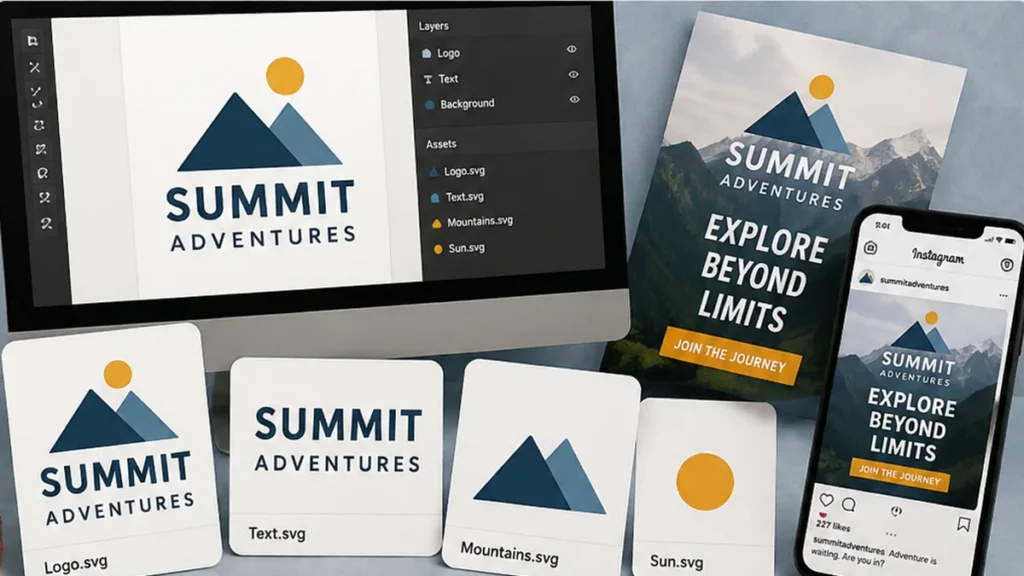
Yes. AI-generated graphics can be much more useful for real design work when they are created as modular assets rather than as one flattened advertisement.
Transparent artwork, separate text treatments and independent backgrounds give us far more flexibility across posters, banners, social graphics and signs.
We Discovered This Through Reuse
A finished promotional graphic may look excellent in its original format. Then the next request arrives: make a wider banner, a square social image, a large window sign or a version on a different background.
If the artwork and text are inseparable, every adaptation becomes a partial rebuild.
The Asset-System Approach
Instead of thinking only about the finished first image, we started thinking about the pieces we might need later: subject artwork on transparency; text/logo treatment on transparency; optional background; and a composed finished version.
Now the same visual idea can be recombined rather than regenerated from scratch.
Transparency Is More Than Removing White
A useful transparent asset needs clean edges, sensible antialiasing and no unintended halo from the original background. It also needs enough resolution for the intended use.
The absence of a visible background does not automatically make an asset production-ready.
Separate Text Is Especially Valuable
Text generated inside images can be harder to revise than ordinary layout text. Keeping the lettering treatment separate allows spelling corrections, legal lines, pricing changes and format-specific hierarchy without disturbing the artwork.
Think About Print Early
A transparent asset that works on a phone may still be too small for a large printed sign. For print-oriented reuse, plan the source dimensions and final output requirements before assuming that “transparent” means infinitely scalable.
Where AI Helps Most
AI is excellent for generating the visual concept and reusable subject art. Conventional design/layout tools remain useful for exact typography, dimensions, final composition and print preparation.
The combination is stronger than forcing one generated image to do every job.
Worthy Trying Verdict
Worked: Yes
Reuse value: High
Best practice: Separate artwork, text and background when future adaptation is likely
Human oversight: Medium
The lesson: When creating AI graphics, think about the asset system—not merely the first finished image.