Quick Answer
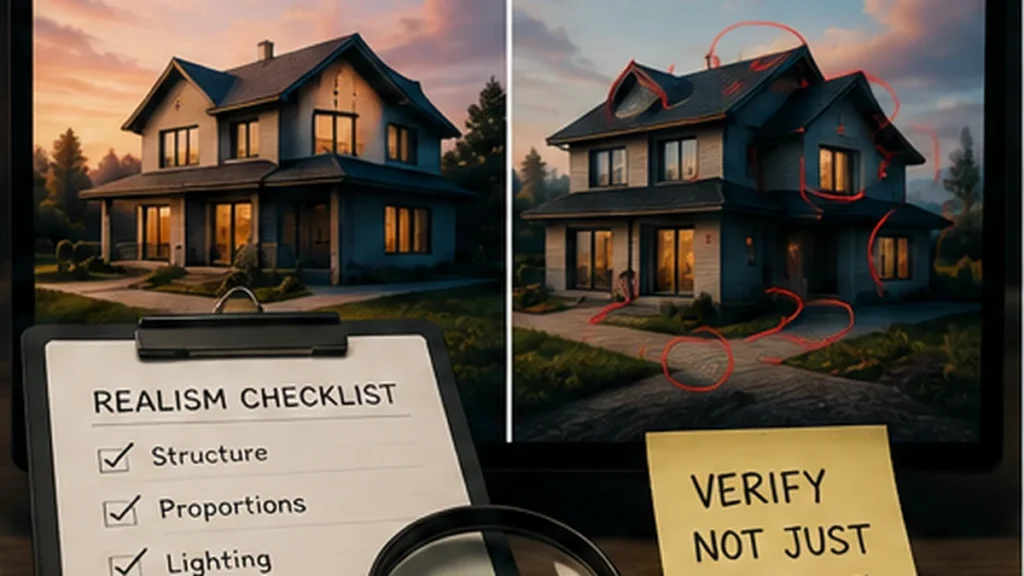
AI images can reproduce the appearance of reality extremely convincingly while getting structural, spatial or functional details wrong.
Visual realism should never be treated as proof of factual accuracy.
The more an image teaches, demonstrates or documents, the more important independent verification becomes.
Photorealism Is Persuasive
Human vision is accustomed to photographs being evidence that something existed in front of a camera. AI breaks that old shortcut.
A generated image can contain realistic lighting, materials, shadows and camera behavior even when the depicted object could not work as shown.
Where We Saw the Problem
Construction imagery made this obvious. A shelf, cart or storage station could look entirely believable while hiding impossible joinery, inconsistent supports or dimensions that did not reconcile with the written plan.
The image did not look “bad.” That was the problem. Its realism made the structural mistake easier to trust.
Other Examples Are Easy to Imagine
A realistic machine can contain controls that do not exist. A medical-looking illustration can place a component incorrectly. A wiring diagram can connect the wrong points. A product image can quietly change features.
In every case, visual polish and factual accuracy are different variables.
Decorative and Instructional Images Need Different Standards
For a mood image or conceptual illustration, exact physical accuracy may not matter.
For an instructional image, comparison, diagram or visual used as evidence, it matters a great deal. We therefore scale verification with the job the image is doing.
Our Rule: The More an Image Teaches, the More It Must Be Verified
If an image is only helping the page feel visually engaging, check relevance and quality.
If it tells the reader where a brace goes, what a control looks like or how two parts connect, compare it against the underlying specification or trusted reference.
Text and Image Should Share a Source of Truth
For physical build content, our strongest workflow is not to make the article imitate the image or the image imitate the article. Both should come from the same validated design specification.
That gives us something objective to compare against when either one drifts.
Realism Is Still Valuable
None of this makes photorealistic AI imagery useless. Realistic images can orient readers, demonstrate concepts and create compelling presentation.
The mistake is allowing aesthetic credibility to substitute for evidence.
Worthy Trying Verdict
Photorealism: Often excellent
Factual guarantee: None
Main risk: Realism creating undeserved trust
Best defense: Verify details against the source of truth
Human oversight: High for instructional or factual imagery
The lesson: Ask “Is this accurate?” separately from “Does this look real?”