Quick Answer
Use AI aggressively when the task is bounded, reversible, easy to inspect and strengthened by speed or synthesis.
Use AI with human review when the task is useful but errors have meaningful consequences or hidden dependencies.
Keep humans firmly in control when the task requires accountability, nuanced real-world judgment, sensitive decisions, security ownership or expertise that the reviewer cannot independently evaluate.
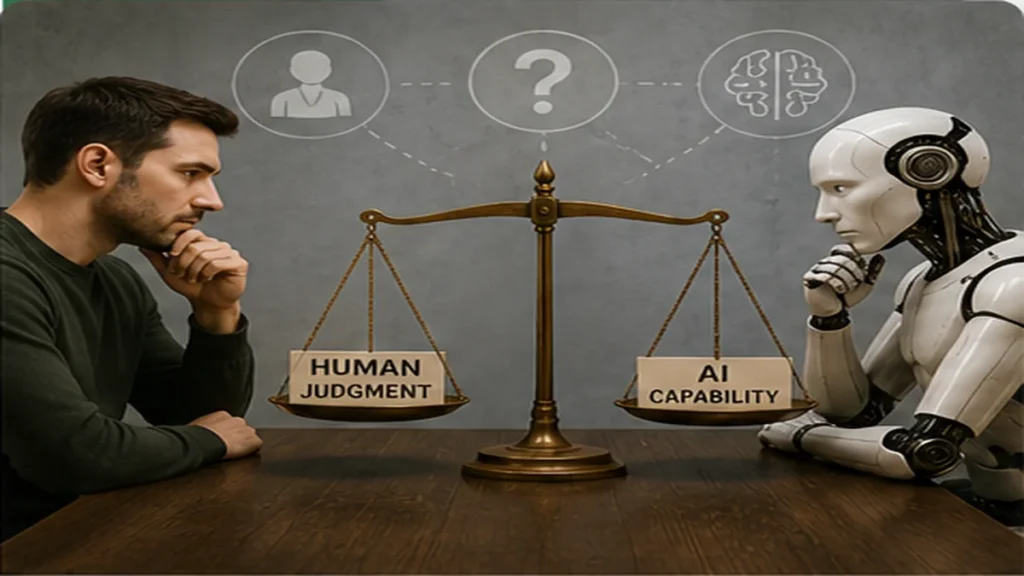
The best answer is often not AI or human. It is a division of labor.
Question 1: What Is the Cost of Being Wrong?
This is the fastest filter.
A weak headline costs almost nothing.
A wrong construction dimension can waste material or create danger.
A bad code suggestion in a public-facing authentication system can create a security problem.
Higher consequence means stronger human ownership and verification.
Question 2: Can We Tell Whether the Result Is Good?
AI is much safer when the user can recognize failure.
If we understand the subject, we can judge a rewrite.
If code can be tested, we can observe behavior.
If we lack the expertise to notice a confident error, delegating the decision itself becomes riskier.
Question 3: Is the Task Reversible?
Brainstorming, drafting and reorganizing information are easy to undo.
Publishing, deploying, purchasing, deleting data or making consequential decisions may not be.
Reversibility lets AI take a larger first role.
Question 4: Does the Task Depend on Hidden Context?
A standalone draft can be easy.
A change to a mature codebase can be hard because important dependencies may be invisible.
A long-running project may contain historical decisions that are difficult to reconstruct.
Hidden context pushes the task toward human supervision or better context engineering.
Question 5: Does the Task Require Accountability?
Some decisions need a person who is responsible for the result.
OWASP's secure-coding guidance states this directly for AI-generated code: a human owner should review and be accountable for accepted changes.
The principle generalizes. AI can recommend. Responsibility still belongs somewhere outside the model.
Three Useful Modes
AI-led with inspection: low-risk drafting, organization, brainstorming, formatting and reversible transformations.
AI-assisted, human-approved: coding, research synthesis, SEO decisions, business analysis, factual visuals and other work where AI provides speed but evidence and judgment matter.
Human-led with limited AI support: high-consequence decisions, sensitive judgment, security-critical approval and tasks where the reviewer cannot reliably detect a bad answer.
The Framework Is About Workflow, Not Status
Choosing human control does not mean AI failed.
Choosing AI for a first draft does not mean the human is unnecessary.
The goal is to assign each part of the work to the thing that handles it best.
Our Own Pattern
Across Worthy Trying, AI repeatedly excelled at producing candidates, organizing evidence, comparing options and accelerating iteration.
Humans were most important for setting objectives, deciding what mattered, recognizing project-level lessons, accepting tradeoffs and owning the final result.
External reality handled verification whenever a direct test existed.
Worthy Trying Verdict
AI-led: Low-risk, reversible, inspectable tasks
AI-assisted: Most substantial knowledge and production work
Human-led: High-consequence judgment and accountability
Best deciding factors: Consequence, testability, reversibility, context and expertise
The lesson: Do not ask whether AI can do the task. Ask which parts AI can accelerate without giving away the judgment and responsibility the task still requires.