Quick Answer
Word count can describe an article.
It cannot tell us whether the article is good.
We learned this after using length and section-depth measurements as proxies for whether AI-generated articles were substantial enough.
Those measurements helped expose some genuinely shallow content.
Then the proxy started influencing the writing itself.
Longer began to look safer.
That created a new problem: AI is extremely capable of producing more words without producing more value.
Why We Used Word Count
The original reasoning made sense.
We didn't want thin, superficial articles.
If an article contained only a few hundred words about a subject that clearly required explanation, that was a useful warning sign.
Word count gave us something measurable.
The problem came when a warning signal gradually became a production target.
AI Can Satisfy a Length Requirement Very Easily
Tell AI:
"This needs another 1,000 words."
It can produce them.
But where should those words come from?
If the subject has a genuine information gap, great.
If it doesn't, the model can still expand introductions, examples, transitions, background, summaries, FAQs, and conclusions.
The number goes up.
Reader value may barely move.
We Saw the Proxy Start Driving the Product
Once length became part of validation, articles could be judged against whether sections were sufficiently developed.
That helped identify underdeveloped areas.
But it also created pressure to make naturally narrow subjects behave like large subjects.
Eventually we changed the rule.
Word count could remain useful descriptive information.
It would no longer decide whether an article deserved expansion or whether a topic deserved its own page.
Google Does Not Give Publishers a Magic Word Count
Google's people-first content guidance focuses on original information, substantial and complete treatment, firsthand expertise and whether readers leave feeling they learned enough to achieve their goal.
Its guidance on AI-assisted content likewise emphasizes accuracy, quality, relevance and adding value rather than generating pages at scale merely because automation makes that possible.
That's much closer to the question we now ask.
Our Replacement Test
Instead of:
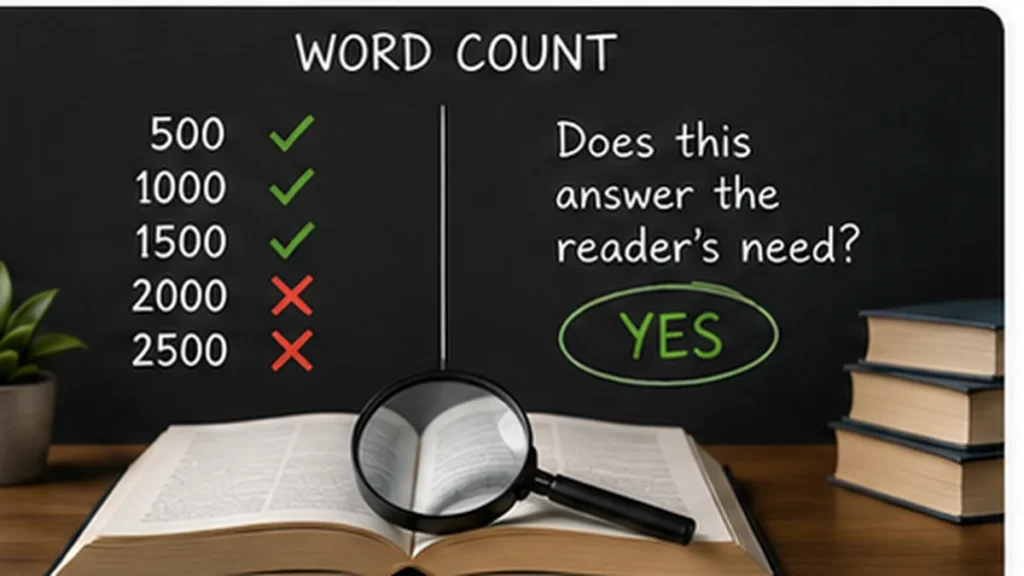
"Is this long enough?"
we ask:
"What important reader need remains unanswered within the page's actual scope?"
If there is one, expand it.
If there isn't one, stop.
Short Can Be Complete
A narrow question may require 900 words.
A complicated practical guide may require several thousand.
Trying to make them equal doesn't create consistency.
It creates distortion.
Long Can Still Be Thin
A 4,000-word article can be thin in the sense that matters to a reader if most of those words repeat, avoid the real question, summarize generic information, or provide no original value.
Length can hide thin thinking remarkably well.
Word Count Still Has a Use
We haven't banned it.
It can reveal anomalies.
If a complicated build guide contains 400 words, investigate.
If a narrow answer somehow contains 7,000, investigate.
The number tells us to look.
It doesn't tell us the verdict.
This Changed Our Entire Content Model
This lesson eventually became bigger than word count.
We stopped trying to manufacture depth through measurements.
Instead: research the real question, define the scope, answer it completely, use firsthand evidence, verify broader claims, and stop when additional material stops helping.
That is much harder to reduce to one number.
It is also much closer to what we actually want to publish.
Worthy Trying Verdict
Is word count useful information? Yes
Is it a quality score? No
Should it trigger automatic expansion? No
Should short articles automatically be rejected? No
Human editorial judgment: Required
The lesson: Measure the article if the number helps you investigate it. Don't write the article to satisfy the number.