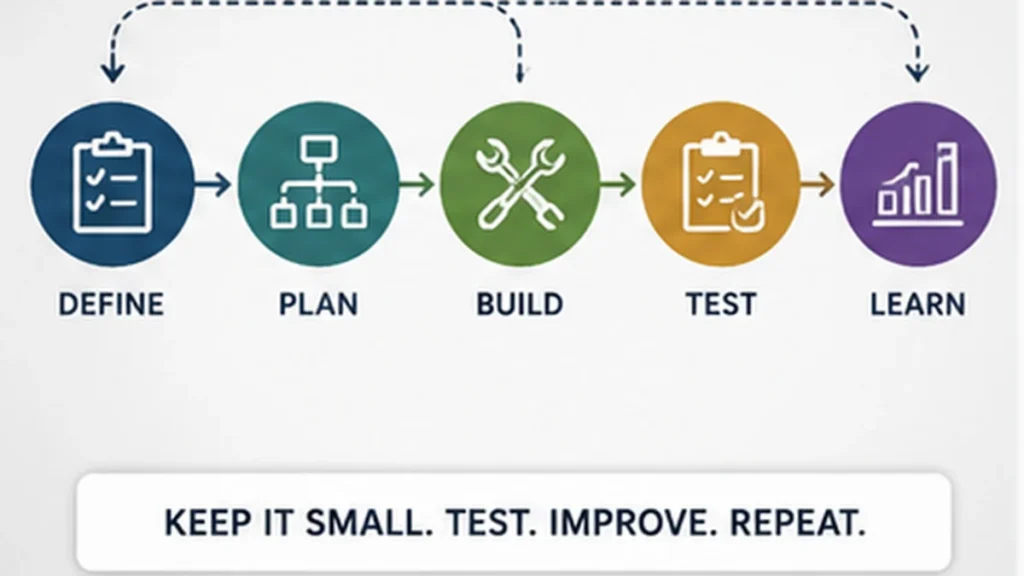
Quick Answer
Start with the smallest process that can produce one genuinely good finished result.
Repeat it.
Track recurring failures.
Add a permanent rule, validator or stage only when it prevents a meaningful problem often enough to justify its cost.
Then periodically remove mechanisms whose original reason no longer exists.
Our Workflows Did Not Start Bloated
They became bloated one sensible fix at a time.
A missing detail created a check.
An image problem created a validator.
A special case created a branch.
Each addition had a reason. The accumulated system eventually became slower than the problem it was designed to solve.
Begin With a Minimal Production Loop
For many creative and informational tasks, a useful starting loop is:
Research or gather evidence.
Lock the scope.
Produce the result.
Verify the meaningful risks.
Publish or use it.
That is enough until reality proves another stage is needed.
Make Complexity Earn Its Place
Before adding anything permanent, ask:
What recurring failure does this prevent?
How often does that failure occur?
What does this step cost every time the workflow runs?
Could a clearer core rule solve the same problem?
If those questions do not produce a strong answer, fix the local output instead.
Do Not Automate a Weak Process
Automation magnifies whatever process it receives.
If the underlying editorial decision is poor, faster generation creates poor content faster.
If an image specification is missing, automating image production multiplies inconsistency.
Prove the result before optimizing throughput.
Keep Verification Focused
Trying to validate everything creates its own failure mode.
Check the areas where errors are consequential or recurrent.
A code workflow needs execution and regression checks.
A build article needs dimensional reconciliation.
A reflective article does not need those same validators.
Schedule Simplification
Workflow maintenance should include deletion.
Ask what each permanent mechanism still protects against.
Remove obsolete requirements, combine duplicates and replace several narrow rules with a clearer principle when possible.
Measure Finished Effort, Not Generation Speed
A workflow that creates a draft in 30 seconds but requires two hours of correction is not necessarily faster than one that creates a stronger draft in five minutes.
Measure the effort required to reach an acceptable final result.
Worthy Trying Verdict
Best starting point: Minimal complete workflow
When to add complexity: After a recurring consequential failure
When to remove complexity: When its reason disappears
Best metric: Time and effort to acceptable final output
The lesson: A mature AI workflow is not the one with the most safeguards. It is the one where every permanent step still earns its cost.