Quick Answer
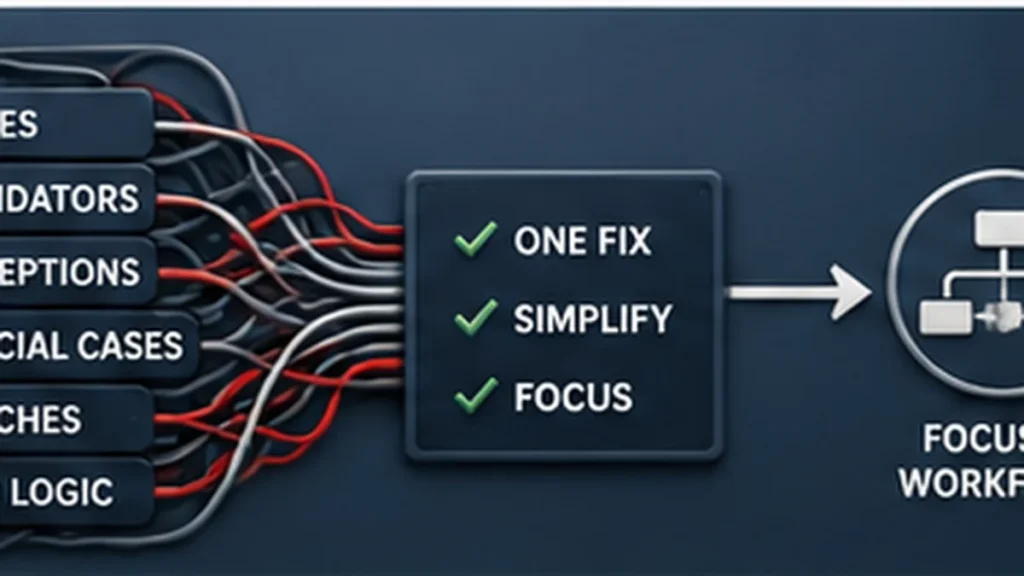
AI workflows tend to become bloated when each failure creates another permanent rule, validation step, exception or specialized process.
The individual fixes may be reasonable while the accumulated system becomes inefficient.
We experienced exactly that. Our workflow did not become complicated because we intentionally designed a complicated system. It became complicated because we kept solving local problems without regularly asking whether the whole process was still helping.
How Bloat Actually Happens
A missing detail creates a check.
An image inconsistency creates an image process.
A formatting problem creates another requirement.
A shallow article creates a depth measurement.
A special case gets its own branch.
Each addition has a story behind it. That makes removing anything feel risky.
The History Starts Running the Workflow
Eventually the process can become a map of everything that ever went wrong.
The problem is that past failures do not all deserve permanent infrastructure.
Some were caused by an old model, an abandoned format, a one-time misunderstanding or a requirement that no longer exists.
If the mechanism remains after the reason disappears, the workflow carries dead weight.
More Checks Can Create More Failure Points
Every additional stage creates another handoff.
Every handoff creates another opportunity for context to change, a rule to be interpreted differently or a correction to affect something else.
A validator can also produce false confidence if it measures a proxy rather than the actual goal.
We saw this when measurable article characteristics began exerting too much influence over editorial decisions.
The Question That Helped Most
Before adding a permanent mechanism, we now ask:
“Is this a recurring structural problem or something that needs fixing once?”
If it is recurring and consequential, it may deserve a rule.
If it is local, fix the output and move on.
Periodic Simplification Is Maintenance
Simplification should not wait until the workflow is unusable.
Periodically inspect permanent rules and ask what failure each one still prevents.
Remove duplicates.
Replace several narrow rules with one clearer principle when possible.
Retire requirements tied to abandoned processes.
This is maintenance, not lowering the standard.
The Goal Is Not Minimalism
A two-step workflow is not automatically better than a six-step workflow.
Some work genuinely needs research, specification, production and verification.
The goal is justified complexity.
Every permanent stage should either prevent a meaningful failure or enable something valuable that would otherwise be difficult.
Worthy Trying Verdict
Problem observed: Yes
Main cause: Local fixes becoming permanent infrastructure
Best solution: Periodic simplification
Human oversight: Medium at workflow level
The lesson: Don't turn every AI mistake into permanent infrastructure. Make complexity earn its place.