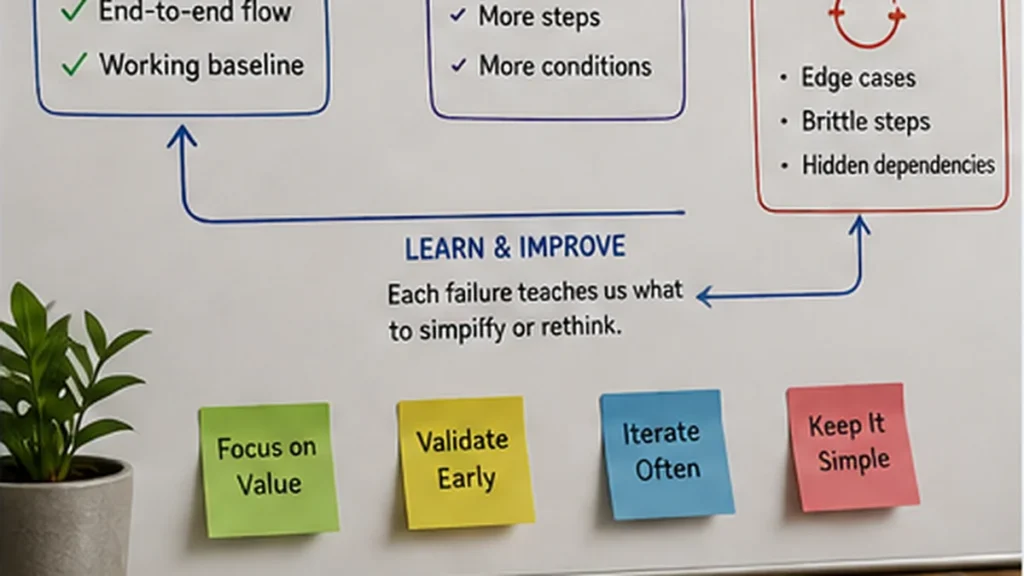
Quick Answer
We would begin with the smallest workflow capable of producing one genuinely good finished result.
Then we would repeat it.
Only recurring, consequential failures would justify permanent complexity.
That is the opposite of trying to design the perfect large-scale AI system before we know what will actually go wrong.
We Would Start Smaller
Our instinct on a large project was to think ahead.
How will we validate hundreds of outputs?
How will we automate images?
How will we enforce consistency?
Those are legitimate questions.
They are also easy to answer prematurely.
We Would Not Engineer Around Imagined Failures
Some safeguards are obvious and necessary from the beginning, especially where safety, security or irreversible consequences are involved.
But many workflow problems are specific to the actual work.
Designing elaborate mechanisms before producing real outputs risks solving problems that never become important while missing the ones that do.
We Would Prove the Output Before the Scale
A scalable system for weak output is not an achievement.
We would first prove that the thing being produced is genuinely useful.
For content, that means proving the editorial model.
For code, proving the behavior.
For a business workflow, proving that the result saves enough time or improves enough quality to justify automation.
Then We Would Repeat It
One successful result can be luck or unusually heavy intervention.
Repeat the process enough times to see what actually varies.
Which problems recur?
Which corrections happen only once?
Where does human judgment repeatedly become necessary?
That evidence should shape the production system.
We Would Keep a Small Source of Truth Early
We would also separate current project decisions from conversation history much sooner.
That makes future simplification, fresh chats and tool changes much easier.
We Would Measure Finished Results
Generation speed can be misleading.
We would measure how much effort it takes to reach an acceptable final result, including review, correction and verification.
That tells us whether the workflow is actually saving anything.
We Would Let Complexity Be Earned
A permanent rule should have a reason.
A validator should catch a meaningful recurring failure.
A new stage should change an important decision or reduce risk.
If it cannot justify itself, it should not be added merely because the system feels more professional with another layer.
The Simple Starting Loop
Our preferred starting loop today would be:
Define the objective.
Identify essential constraints.
Produce something real.
Inspect it.
Repeat.
Track recurring failures.
Improve the process where the evidence supports it.
Worthy Trying Verdict
Biggest change: Start with a working result, not a large system
Complexity: Earned gradually
First scaling test: Repeatability
Human oversight: High at the beginning
The lesson: Make one thing work before engineering the system that will supposedly make a thousand.