Quick Answer
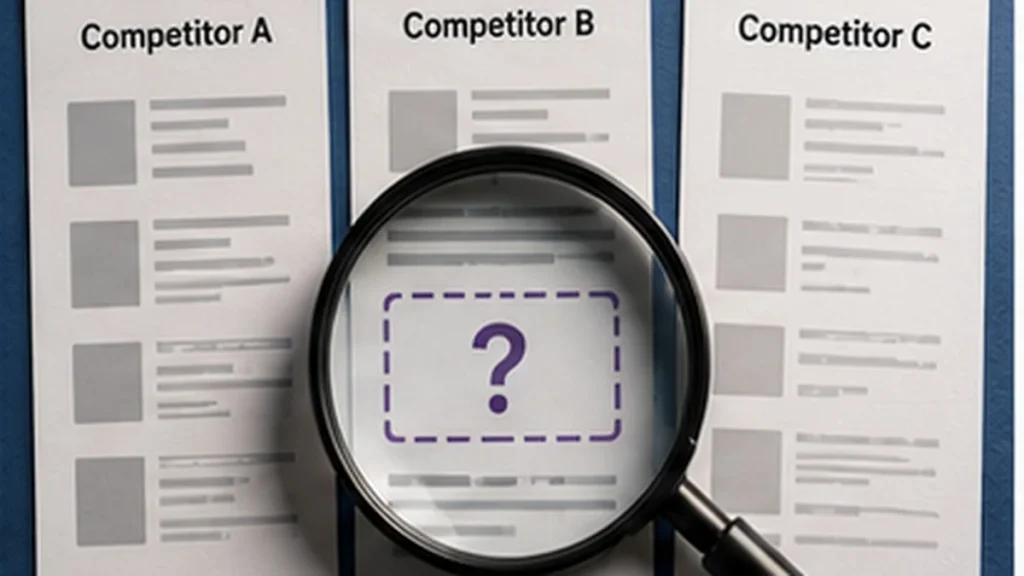
AI is very useful at comparing multiple competing pages and identifying missing questions, weak explanations, absent examples and organizational opportunities.
But an omission is not automatically an opportunity. If five competing articles ignore a detail because readers do not need it, adding that detail does not make a sixth article better.
Our rule became simple: a content gap matters only when filling it helps the intended reader understand, decide, avoid a mistake or complete the task.
Why AI Is Good at This
Content-gap research is fundamentally a comparison problem. One page may explain definitions well but skip practical steps. Another may include steps but never explain tradeoffs. A third may answer beginner questions while assuming knowledge that a first-time reader does not have.
Reading all of those pages manually is possible. AI makes the synthesis much faster because it can compare the pages as a set rather than treating each one independently.
The Trap: Difference Is Not Value
The easiest bad version of content-gap research is a checklist of everything competitors failed to mention.
That produces novelty without usefulness.
We now challenge every proposed gap with a reader-value test: Would this missing information help someone make a decision, avoid a mistake, understand the subject or complete the task? If not, the difference is interesting but not editorially important.
A Better Gap Analysis
We separate gaps into useful categories: unanswered reader questions; weak explanations; missing evidence or examples; missing decision criteria; missing failure cases; and poor organization that makes existing information difficult to use.
This is more useful than simply asking which keywords appear on one page but not another.
Competitors Are Evidence, Not the Outline
A recurring lesson in our SEO work is that competing pages can reveal what the market currently covers without dictating our structure.
If every ranking page has the same ten headings, copying those ten headings does not create a better article. We want to understand why those topics recur, then decide what the reader actually needs and what our own experience can add.
Where Firsthand Experience Becomes the Advantage
AI can identify a missing topic. It cannot manufacture genuine firsthand experience simply because that experience would be useful.
That is where our failures and experiments become valuable. If competing pages discuss AI image consistency only as a prompting problem, for example, our own work can add the distinction between visual-style consistency and exact physical-object consistency.
How We Would Use It
Our practical loop is: collect current competing pages; summarize the reader job each page serves; identify repeated coverage; identify missing or weak coverage; score proposed gaps by reader value; add only the gaps that improve the answer; then build the article around the reader rather than around the competitors.
Worthy Trying Verdict
Worked: Yes
Best use: Cross-page comparison and synthesis
Human judgment: Medium
Main risk: Treating every omission as an opportunity
The lesson: Find reader-value gaps, not merely competitor differences.