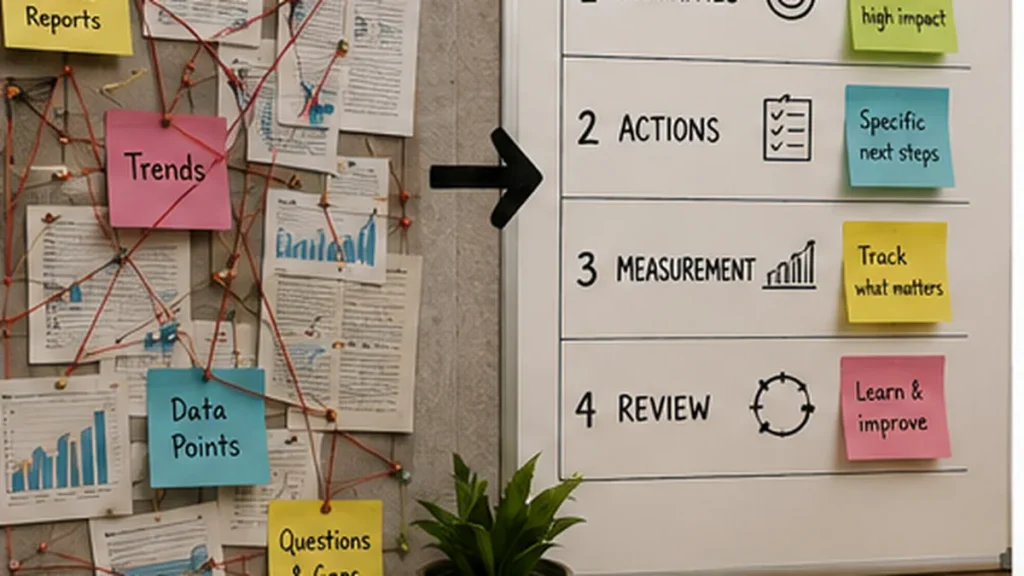
Quick Answer
Yes. Turning research into an ordered plan is one of the most useful AI tasks we have tested.
Research is easy to accumulate.
Action is harder.
AI can take a large collection of observations and reorganize it around what matters most, what can be changed, what should happen first and how the result could be measured.
The best plans, however, keep a distinction between what is known, what is suspected and what still needs testing.
Forty Observations Are Not a Strategy
A research project can easily produce dozens of findings.
A business owner usually does not need another list.
They need answers to questions such as:
What matters most?
What can we actually change?
What should happen first?
What will it cost?
What evidence supports the recommendation?
How will we know whether it worked?
AI is particularly good at reorganizing information around those questions.
Why Synthesis Is Valuable
Humans can become attached to the order in which information was discovered.
AI does not have to preserve that order.
It can regroup findings by impact, effort, uncertainty, owner, timing or dependency.
That can reveal that several apparently separate observations all point to one underlying issue.
For example, unclear pricing, weak calls to action and repeated customer questions may all belong to a larger conversion problem.
Prioritization Needs an Objective
“Make an action plan” is not enough.
A plan for maximizing occupancy may prioritize different work from a plan for increasing profit per customer.
A plan for a one-person business may make different tradeoffs from one for a staffed organization.
We therefore want the objective and constraints stated before AI ranks the work.
Beautiful Plans Can Still Be Built on Weak Assumptions
This is the central risk.
AI can produce:
Phase 1.
Phase 2.
KPIs.
Timelines.
Priorities.
The document can look impressively strategic even when the evidence underneath it is weak.
Structure does not rescue a bad premise.
Attach Evidence to Recommendations
Instead of:
“Do X.”
we prefer:
“Evidence A and B suggest X may address Y. Test it this way and measure Z.”
Now the recommendation can be challenged.
If the evidence is weak, we know.
If the test fails, we learn something.
If the metric improves, we have a reason to continue.
The plan becomes falsifiable rather than merely persuasive.
Separate Known, Suspected and Unknown
A useful action plan can explicitly classify its inputs.
Known:
directly supported by the available evidence.
Suspected:
a reasonable interpretation that still needs confirmation.
Unknown:
information required before making a confident decision.
This prevents AI from flattening different levels of certainty into one confident narrative.
Order Actions by Learning as Well as Impact
Sometimes the best first step is not the largest change.
A small test may resolve an uncertainty that affects several later decisions.
For example, before redesigning an entire marketing strategy, a business might first verify whether customers actually misunderstand the offer we believe is unclear.
AI can help identify these high-information tests.
Measurement Closes the Loop
A useful plan should define what happens after implementation.
Did inquiries increase?
Did booking conversion change?
Did support questions decline?
Did users reach the intended page?
Did the technical error disappear?
Without measurement, the action plan becomes another static document.
With measurement, it becomes the beginning of the next research cycle.
Why This Generalizes Beyond Business
The same structure works for many AI-assisted projects.
Research.
Separate evidence from inference.
Prioritize.
Act.
Measure.
Feed the result back into the next decision.
AI is strong at helping organize that loop because it can keep many observations in view at once.
Human judgment remains responsible for the real-world tradeoffs.
Worthy Trying Verdict
Worked: Yes
AI strength: Synthesis and prioritization
Main risk: Structured plans built on weak assumptions
Best improvement: Attach evidence and measurement to recommendations
Human role: Accept tradeoffs and decide what actually gets done
The lesson: The best AI action plan does not hide uncertainty. It turns uncertainty into the next thing to test.