Quick Answer
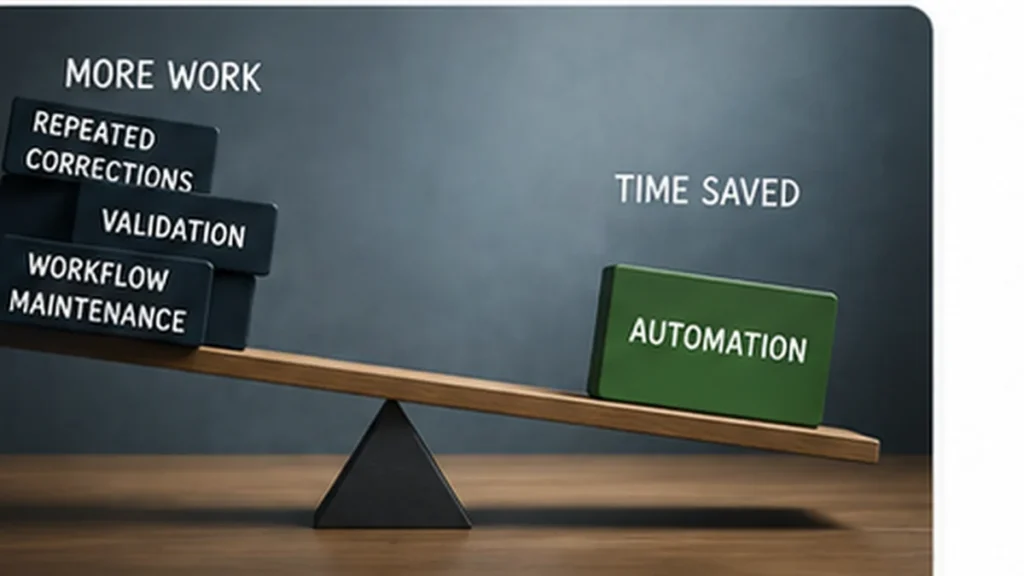
AI creates more work than it saves when the cost of prompting, checking, correcting and maintaining the AI workflow exceeds the effort required to produce the useful result another way.
We experienced this firsthand.
AI could generate output extremely quickly.
But some of our workflows accumulated so much correction and validation that generation speed stopped being the meaningful measurement.
We learned to measure finished-result effort, not generation speed.
Fast Generation Can Hide Slow Production
Suppose AI creates an article in three minutes.
That sounds incredibly efficient.
Then we spend twenty minutes correcting scope, fifteen fixing repetition, another round checking facts, several image iterations, and more time getting the final package into the required format.
The three-minute generation time isn't the production time.
The entire path to an acceptable result is.
We Ran Into This With Images
Generating an image could be fast.
Getting multiple images to depict the same physical design accurately was another matter.
Each regeneration could change something else.
If the article depended on visual consistency, the correction loop could consume the time AI supposedly saved.
That doesn't mean AI image generation is bad. It means that particular workflow had poor economics.
We Ran Into It With Validation Too
Validators were intended to save us from weak content.
But every validator created another output to interpret.
A false alarm required investigation. A bad proxy could cause unnecessary rewriting.
Eventually we had to ask whether the validation system itself was earning its cost.
The Correct Metric Is Not 'Could AI Do It?'
AI can do an astonishing number of things.
That's not the same question as:
"Is AI the most efficient way to do this particular job?"
For some work, absolutely.
For other work, AI is useful for only one part.
And occasionally the manual or conventional approach is simpler.
Calculate the Whole Loop
We now think about setup time, generation time, human review, correction rounds, verification, maintenance, and failure recovery.
That is the real cost.
Quality Matters Too
The fastest workflow isn't automatically best.
A slower AI-assisted process can still be worthwhile if it produces a substantially better result.
So the actual comparison is:
time + quality + reliability + repeatability.
Not merely seconds per generation.
When AI Has Been Extremely Valuable for Us
AI has been particularly strong when a lot of accumulated information needs organizing, many related ideas need extracting, code has a clear expected behavior, research needs synthesis, or an existing result needs focused transformation.
The 46-article project itself is a good example.
The articles can be produced quickly now because the expensive learning happened during weeks of earlier work.
AI is compressing the publication step, not magically eliminating the research.
Worthy Trying Verdict
Does AI always save time? No
Can it save enormous amounts of time? Yes
Best metric: Effort per acceptable finished result
Human oversight: Depends on failure cost
Would we abandon AI when a workflow becomes inefficient? We'd change the workflow first
The lesson: Measure how long it takes to reach a result you can actually use, not how quickly AI produces its first answer.