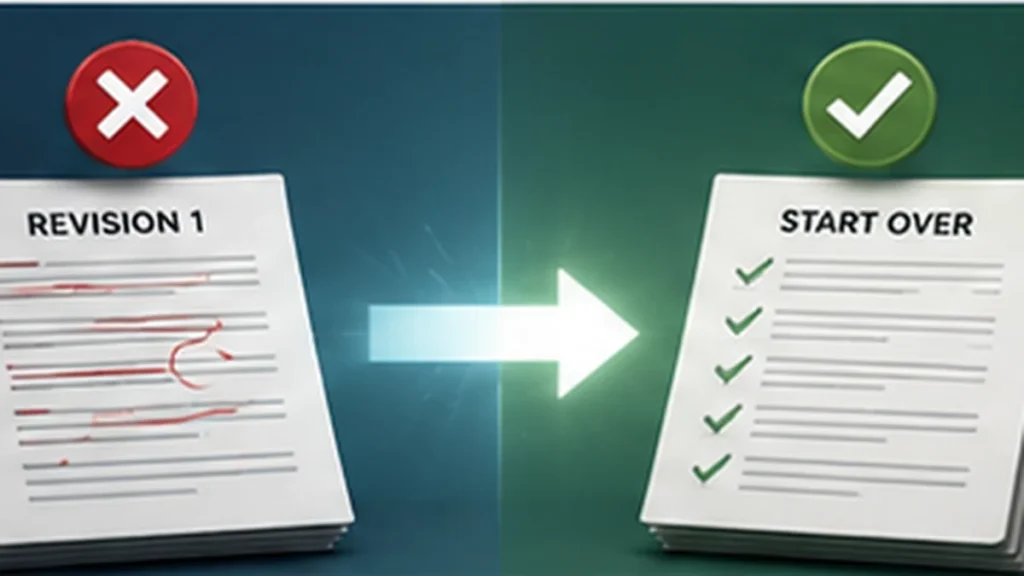
Quick Answer
Starting over can work better than another AI revision when the current result is built on a bad foundation and each correction is merely patching symptoms.
We learned this after long correction chains in content, workflows and code.
A revision preserves much of what already exists. That is useful when the foundation is sound.
When the foundation is wrong, preservation becomes the problem.
Revision Has Momentum
Ask AI to revise an existing output and the existing output becomes powerful context.
Its structure, assumptions and earlier decisions all influence the next version.
That is usually efficient.
It also means a flawed premise can survive through many generations because every new version begins from the previous one.
Patch Stacking Is a Warning Sign
We became suspicious when the instructions started sounding like this:
Keep everything except this.
Undo the change from two versions ago.
Preserve this section but rewrite the logic underneath it.
Don't reintroduce the thing we removed earlier.
At some point, the correction history can become more complicated than the desired result.
A Clean Restart Changes the Context
Starting over does not mean forgetting what we learned.
It means extracting the corrected requirements and rebuilding from those requirements rather than from the damaged artifact.
That can remove accidental structure, obsolete workarounds and assumptions that no longer deserve to survive.
When Revision Is Better
Do not restart merely because a result is imperfect.
Revision is usually better when:
the architecture is sound;
the problem is localized;
most of the work is valuable;
or a rewrite would risk losing important behavior.
Starting over has its own verification cost.
When Restarting Becomes Attractive
A restart is more attractive when:
the same failures keep returning;
requirements have changed substantially;
the output is mostly patches;
nobody can explain why certain parts still exist;
or describing the corrections takes longer than describing the desired result.
Preserve the Lessons, Not Necessarily the Artifact
This became our guiding idea.
The failed version still has value because it taught us what the next version needs.
We keep the requirements, constraints and discovered edge cases.
We do not automatically keep the structure that produced the failure.
Worthy Trying Verdict
Is restarting always better? No
When is it useful? When the foundation, not a local detail, is wrong
Main risk of endless revision: Preserving bad assumptions
Main risk of restart: Losing hidden requirements
Best practice: Extract current requirements before rebuilding
The lesson: Do not confuse preserving previous work with preserving progress.