Quick Answer
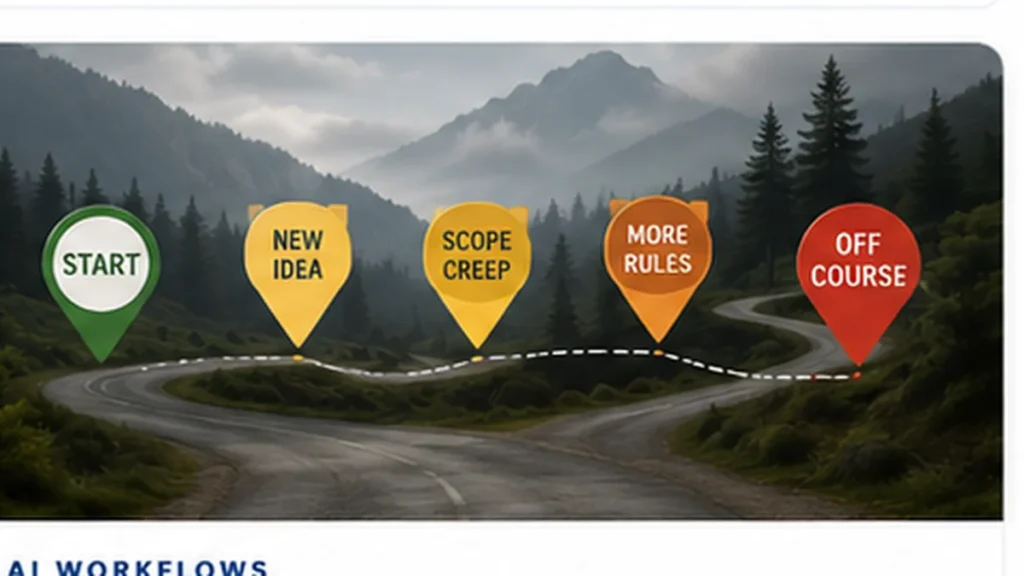
AI project drift is what we call the gradual movement of a long AI-assisted project away from its actual objective.
It doesn't necessarily happen through one dramatic mistake.
In our experience, it happened through many reasonable-looking changes: a new rule, a workaround, a temporary experiment, a validator, an exception, another production stage.
Eventually we could still be following the process while no longer optimizing for the original goal.
Drift Is Hard to Notice Because Every Step Can Look Reasonable
Suppose the objective is simple:
"Produce a useful article efficiently."
The first article has a problem. We create a check. Another article fails differently. We create another check. Images introduce inconsistencies. We add a visual workflow. The workflow becomes slow. We add automation. The automation needs validation.
Nothing in that sequence is obviously absurd.
But eventually the project may be optimizing for:
"Successfully pass the production system."
That's not the same objective.
We Experienced This Directly
Our content workflow accumulated mechanisms intended to protect quality.
Some were useful. Others became proxies.
Article measurements started influencing production decisions more strongly than the reader's actual need.
Image workflows added multiple iterations without reliably solving consistency.
The system became increasingly sophisticated while the desired output remained simple: a genuinely useful finished page.
Recognizing that mismatch was one of our most important lessons.
Drift Can Affect More Than Content
The same pattern can happen in software, research, business planning, design, automation, and long conversations.
A project begins with an outcome. Over time, maintaining the machinery becomes part of the outcome.
Warning Signs
We now watch for several signs:
You can explain the workflow better than the objective.
Old rules remain after their reason disappears.
Success means passing internal checks rather than producing the desired external result.
Exceptions keep multiplying.
Starting fresh feels easier than understanding the current process.
A Source of Truth Helps
One solution is maintaining a concise statement of what is currently true: the objective, current constraints, important decisions, and actual quality standard.
The history can remain available. It just doesn't get equal authority.
Ask the Original Question Again
One of the simplest anti-drift tools is:
"If we were starting today, knowing what we know now, would we design the process this way?"
If the answer is no, history may be keeping unnecessary machinery alive.
Worthy Trying Verdict
Did project drift occur? Yes
Was it caused by one bad decision? No
Main cause: Accumulated corrections and process complexity
Human oversight: High at project level
Can it be reduced? Yes
The lesson: Long AI projects rarely drift because everyone forgets the goal at once. They drift because small solutions accumulate until the process becomes the project.